TW & TLWR: talked about death, which might trigger some people’s anxiety. read with caution and don’t take words too seriously. stop reading if you feel uncomfortable. a very incoherent piece of bs that’s gonna take you 5 minutes to read at a speed of 300 words per min.
General flowchart: an okay intro → stuff i saw online → personal identity and psychology → ethics of death → a random summary and a few extra points
Today, i’m diving into something swirling around my head, though I’m not exactly sure what it is. This writing might come out a bit jumbled because my thoughts are all over the place.
Lately, I’ve been thinking a lot about death, not in a gloomy way or anything. I did some googling on the topic, and I have to admit, reading and watching stuff about it made my heart race for a bit. I guess that’s what they call an existential crisis. One thing every human eventually faces is death. It’s like this big mystery nobody really knows about. I asked some friends my age about what they think about death, if it scares them or why. Turns out, a lot of them fear not being able to see the future or being forgotten.
Back in the day, I used to complain about how long life seemed, assuming I’d live till 80. I felt stuck in this never-ending routine, even though I was barely 10 and didn’t know much. But now, bam, I’m already in my twenties, and life doesn’t seem that long anymore. Still though, I hate monotonous life like sisyphus rolling his stone. Yeah, I get it, I have to accept it, it’s just annoying.
I can’t help but wonder what the point of it all is. It’s one of those questions everyone asks themselves at some point, but you never really get a satisfying answer. Out of curiosity, I looked up people’s near-death experiences and what it feels like to be in a coma. Obviously, those aren’t real death, but it gave me a glimpse of what it might be like. Personally, I once blacked out for a few hours after a bike accident (probably had a mild concussion). It was just like others described: a rush of adrenaline followed by nothingness. No pain, no memories, just blank. I guess it’s that emptiness that freaks people out the most.
There’s a ton of stuff connected to death, but I’m only gonna talk about a small part: identity, psychology, and ethics.
You can’t talk about death without talking about life and why we’re here. When you really dig into it, you end up with stuff like existentialism, nihilism, absurdism, and some religious stuff (important but too broad, so I’m skipping it). I’ve bounced around between these different ways of thinking, but right now, I’m kinda sitting between existentialism and absurdism: life is absurd but still gotta create some meaning to it. What does it mean to live? Well, it’s everything from meeting your basic needs to finding your purpose. Why do we live? Probably ’cause we have to, but also ’cause we wanna chase that dopamine hit however we can. To really live your best life, you gotta figure out who you are.
Someone once asked me to define what makes a person, what sets them apart from everyone else. I’ve had this dumb theory since I was a kid: a person is just a mix of possibilities from all the possibilities out there. We’re shaped by all sorts of factors, some of which we control and others we don’t. So basically, we’re a mix of genetics and experiences, all rolled up into one. Sure, we’re all unique in our own way, but when you really think about it, there’s always gonna be someone out there who’s kinda like you.
Then there’s the whole question of whether we stay the same person over time. People change all the time, but can you really change someone else? There are these two extremes: the body theory, which says it’s all about your physical self, and the soul theory, which talks about some unexplainable soul thing (i don’t believe in it but i don’t hate the idea). Everything else such as brains, personalities, and memories lay somewhere in between. I won’t go into details about how each works, my conclusion is they all contribute a little into a personal identity – we change and we don’t change depending on the situation.
Consider this: Imagine someone undergoes a significant shift in personality due to a traumatic brain injury or another life-altering event. Are they still the same person they were before? If not, does that mean the person they used to be has essentially “died” Perhaps we can accept minor changes as a natural part of life, but where do we draw the line? At what point do these changes make someone unrecognizable to their own family? And how much can we trust our own perceptions of who someone truly is?
It’s pretty obvious that what really matters to us as a person lies somewhere around the brain area. One question I love asking myself is: how do you know if you are you, not someone else? Let’s take an extremely specific scenario:
Person X and Person Y were close friends despite their differing beliefs. One fateful day, they were kidnapped by a mad scientist who had a bizarre experiment in mind. This scientist somehow managed to swap X’s thinking and reasoning skills with those of Y. Although X retained all of his memories and personality traits, he found himself thinking like his best friend Y, even on matters they used to disagree on. X pondered over this strange turn of events, attributing it to their close bond.
As the experiment continued, the scientist proceeded to strip away one aspect of X’s personality and memory each day, replacing it with Y’s. Eventually, X’s body contained all of Y’s information, and vice versa. Despite this complete exchange of traits, X and Y were still considered alive, albeit swapped, without any physical brain replacement occurring.
However, the scientist decided to take things further by discarding all of X’s memories and personality traits, along with Y’s body, into a junk machine. Only Y’s memories and personality remained within X’s body. In this scenario, it could be argued that X had effectively “died,” as his essence was replaced entirely by Y’s.
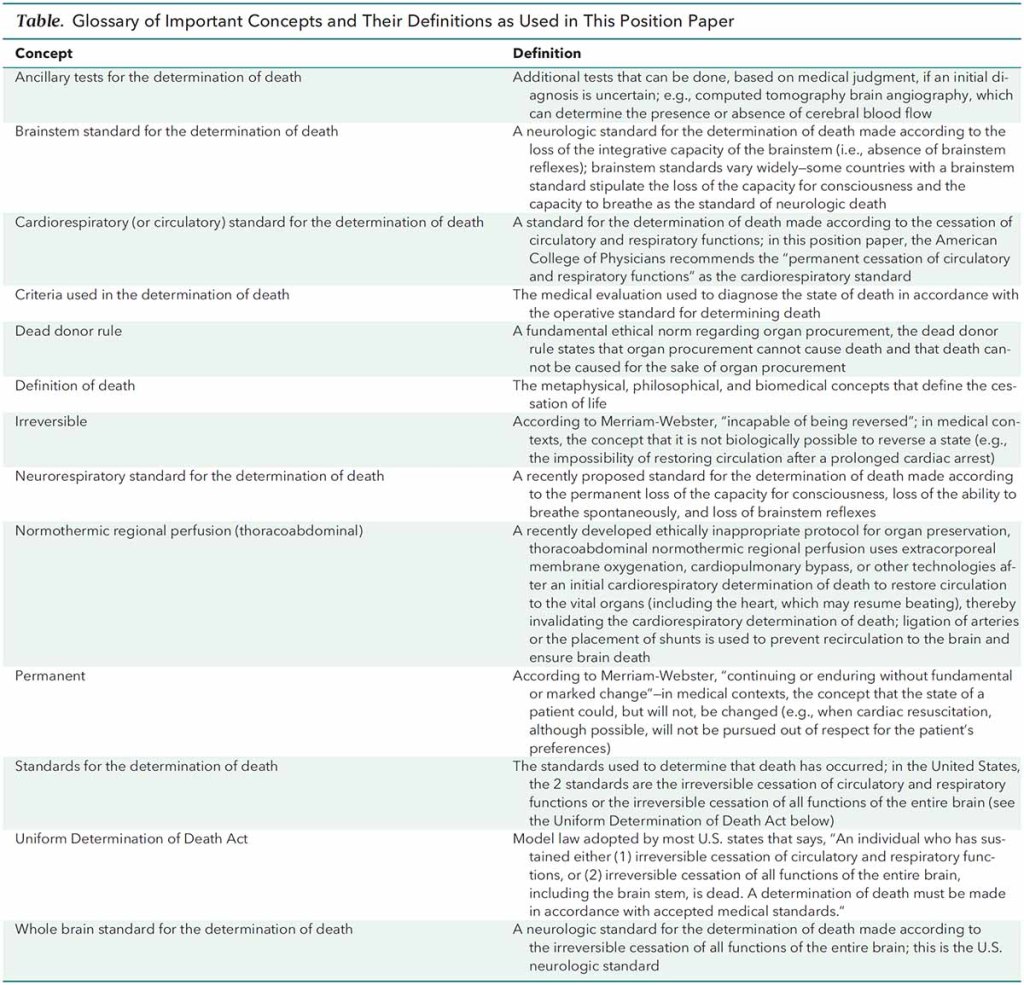
Now, onto the ethical stuff about death. We’re talking about things like abortion, the death penalty, suicide, euthanasia, all that heavy stuff. Morality is all about figuring out what’s right and wrong, but most of the time, there’s no clear answer. The ethics of death involve things like when we say someone’s dead, who gets to decide when someone dies, and how death affects everyone around them.
The reason it’s so hard to agree on this stuff is because everyone’s different, and death is kinda final. When someone dies, it doesn’t just affect them, it affects everyone around them too. Take, for example, a person fell into a deteriorating locked-in state (they couldn’t move or speak at all, but had consciousness), and they wanted to keep living but couldn’t express their desire. The doctor told their family all the possible treatments and outcomes, one of them included minimal treatment and extubation. Then, the family decided to go with minimal treatment. In this scenario, everyone played a role in the death decision process except the person themself. There are many other scenarios that are frequently debated in deciding who gets to do what and where the line should be drawn to mark life and death. (Well, Elon Musk’s chip might change this scenario, but you get what I mean here.)
My head is hurting, so imma wrap it up here.
It’s kinda wild to me how we can all have such different opinions but still agree on some basic stuff. We all go through life forming our own identities, but when it comes down to it, we’re all searching for meaning in one way or another. Then, when we encounter either real or fake scenarios that are linked to life and death, we react in similar ways: curiosity, fear, anxiety, grief, helplessness, etc.
Life’s gonna throw some curveballs our way, like physical decay and loneliness, but that’s just part of the ride. Maybe things will change in the future with all this fancy technology, but one thing that won’t change is that humans are born alone. Don’t dwell on it too much, just enjoy the ride. Just a few weeks ago, I was unsure about the whole concept of building a family, but now I get why it’s a thing.
So yeah, life and death might seem pointless in the end, but the journey’s where it’s at. And who knows, maybe I’ll find my own way to happiness instead of following our ancestor’s old path. But hey, marriage and kids might still be in the cards for me ’cause I love doing human stuff. (actually, 98.99% of chance i will be following our ancestors lol)
Also, there might be a way to achieve immortality one day, but I’m not sure if that’s gonna be a good thing. Plus, I’m probably not going to see it happening in my lifetime → none of my business. But anti-aging and other science researches are very cool. (lol not me going an extra mile to be as neutral as possible)
Thanks for listening to my ted talk today. Catch you next time, and remember to find joy in living.
Love,
Lin
tmi but kinda good to know:
 19til29
Long time no see! I agree with you that every time I think about death, I’m not afraid of what’s gonna happen after it. What makes me really scared is the things that I haven’t experienced which I probably can do if I didn’t die. So after I realized it I gradually started to do everything I want cause I don’t want to feel so regretful if one day accidents find me unfortunately. So just live another life and keep exploring! Good luck to both of us❤️
LikeLike